Article · World Cup series, part 1
What football fandom tells us about Gen Alpha across North America
The FIFA World Cup 2026 kicks off today, and with it comes a once-in-a-generation opportunity for North America to observe how Gen Alpha engages with sport, culture and fandom at scale. For the first time, three nations will jointly host the tournament, but Canada, Mexico and the United States enter it from very different starting points.
For kids and teens, sport sits alongside the rest of their entertainment choices, including gaming, YouTube streaming video, social media and creator content. All compete for a share of a kid’s discretionary time. Major sporting moments are watched, discussed, shared and experience across the same platforms that shape young people’s lives.
This is what makes the World Cup such a powerful lens on this generation, it offers insight into what captures their attention, builds loyalty and generates conversation, revealing attitudes and behaviours that will continue to influence fandom long after the tournament has ended.
20%
of kids and teens express an interest in the FIFA World Cup, whether you ask a child in Mexico City, New York or Toronto.
The Insights Family, Kids Insights, Canada, Mexico and the United States, 2026.
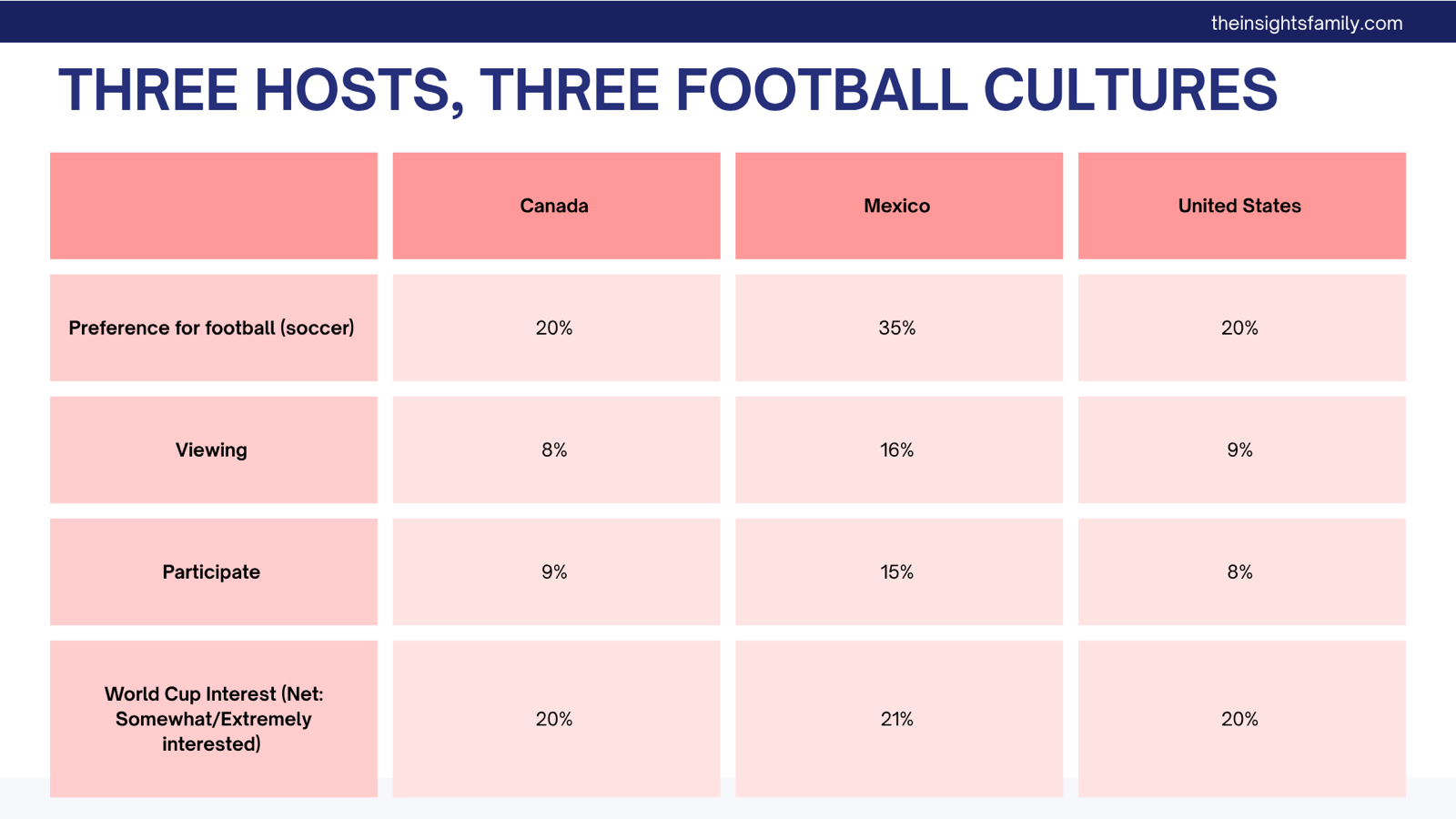
One number remains remarkably consistent across all three countries is that around 20% of kids and teens express an interest in the FIFA World Cup. Whether you ask a child in Mexico City, New York or Toronto, overall interest in the tournament is extraordinarily similar. However, that is where the parallels begin and end. The motivations behind that interest, the ways young people engage with the tournament, the platforms they follow it on and the behaviours it inspires all vary considerably by age and country. Understanding the differences is key to understanding how Gen Alpha experiences the World Cup.
Mexico already operates as a football-first nation. The sport is deeply embedded into youth culture, spanning viewing, participation, identity and family traditions. Football is very much part of the country’s cultural fabric, with 35% expressing a preference for it.
Canada represents a participation-led market, with 9% participating in football, a higher number than US kids (8%). This shows kids are more likely to play football than actively follow leagues or teams, creating an audience built around grassroots engagement, school sport and individual participation rather than elite fandom.
The United States sits somewhere different again. Football or soccer remains secondary to the NFL, basketball and baseball in the wider sports hierarchy, but analysis of the data reveals a substantial entertainment opportunity. Young Americans are increasingly engaging with soccer through content, community and live experiences. Comparing 1 February-30 April 2025 and 1 February-30 April 2026, the proportion who watch on a screen has grown 45% (up from almost 6% to over 8%) whole attendance at live events has increase from 4% to 5% (up 34%). However, the strongest growth has come from kids and teens who follow soccer through social media, websites and other channels rising from almost 3% to nearly 5% (up 78%).
78%
growth in US kids and teens following soccer through social media, websites and other channels, year on year.
The Insights Family, Kids Insights, United States, February to April 2026 versus February to April 2025.
Together these shifts reflect the growing role of soccer in the wider entertainment landscape. Collectively, the three host nations reveal that modern football fandom among kid and teen audiences extends far beyond match attendance or traditional viewing.
Kids engage with football through gaming ecosystems, clips and highlights, content posted on social media, merchandise and apparel, online conversations, creator/influencer culture, team or national identity and tournament moments.
This matters commercially because, like most things in a kid’s life, the World Cup is no longer simply competing against other sports. It is competing inside a broader entertainment economy shaped by TV shows, video games, creator content, streaming platforms and social media.
With around a fifth expressing an interest in the FIFA World Cup across Canada, Mexico and the United States, the tournament offers a rare opportunity to engage Gen Alpha at scale across three different countries. For FIFA, broadcast partners, publishers, sponsors and brands, the goal should not simply be to convert that interest into lasting engagement with the sport. For many kids and teens, the 2026 World Cup will be their first meaningful experience of the competition at an age when they begin to form habits, preferences and loyalties around sport and teams. The organisations that benefit most will be those that use the tournament as a catalyst for enduring participation, whether through content, gaming, social media, grassroots play, merchandise or attending matches in person. In that sense, the World Cup is an opportunity to build relationships with the next generation of football fans.
1. Football means different things in each host nation
Mexico: football as cultural infrastructure
Among the three host nations, Mexico stands out as the clearest football-first culture.
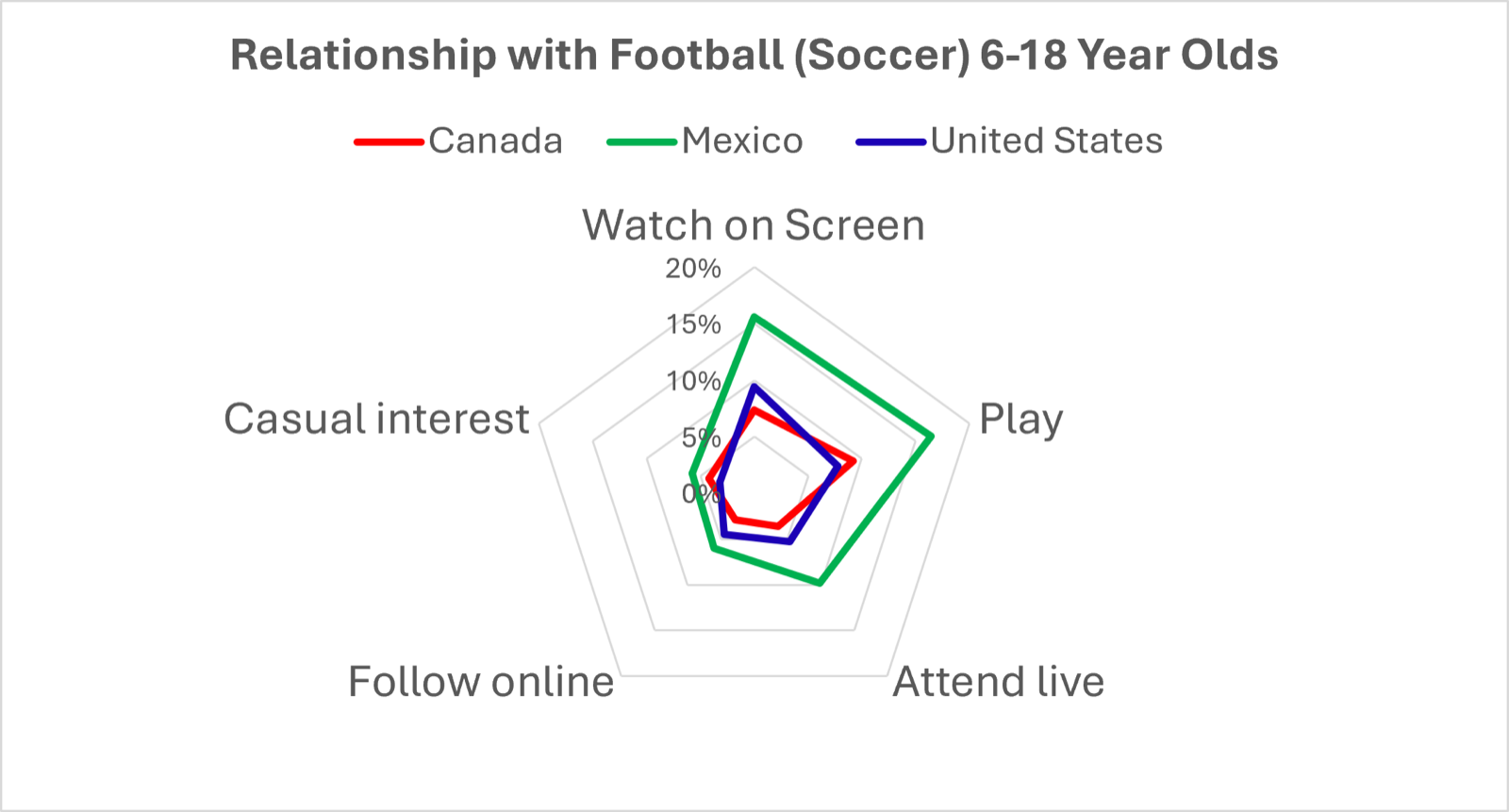
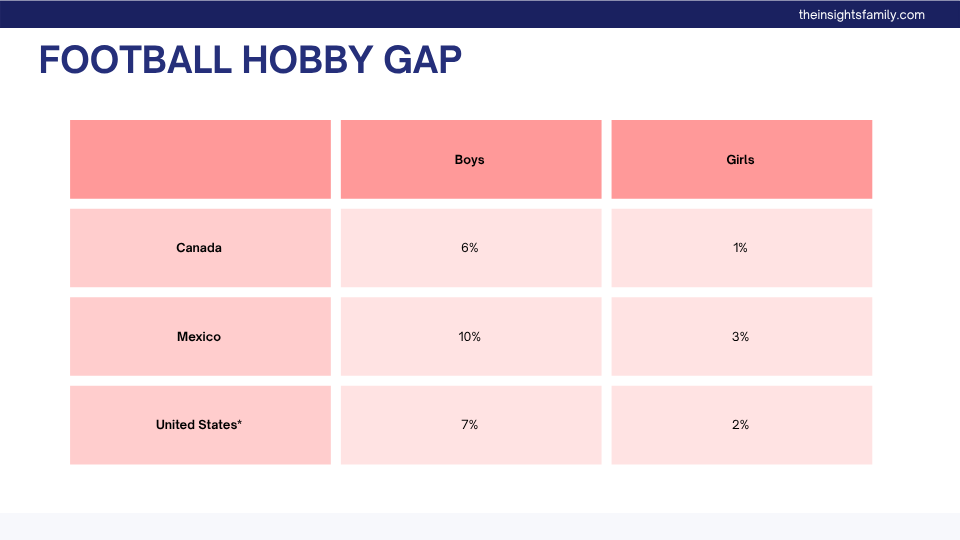
Video games remain the number one hobby among boys ages 3-18 for the six months ending 30 April 2026. Football is ranked second in Mexico (10%), which is almost twice as high as their Canadian peers (6%), while in the U.S., the football figure (7%) is not directly comparable because it may include American football.
Mexican kids and teens also lead across every measured engagement metric, including watching matches, actively participating, social following and at-venue attendance.
The significance of this extends beyond sport itself. Analysis of the data infers football is part of the Mexican population’s DNA. Kids live within a football culture that spans domestic leagues, international competitions, peer conversations, family traditions, and grassroots participation.
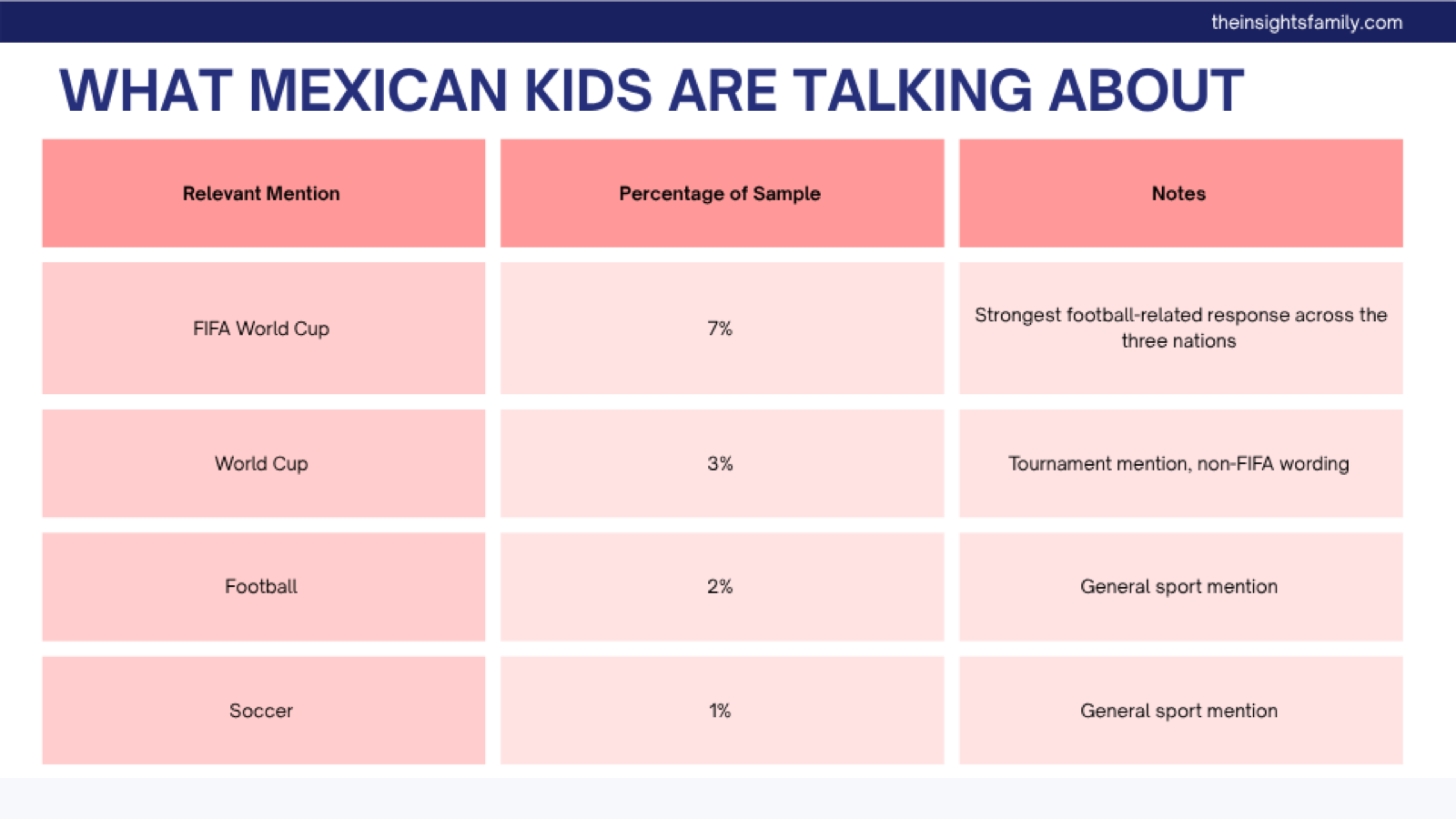
This is reinforced with spontaneous responses children and teens gave when asked what they had been talking about with friends. These conversations are surfaced entirely unprompted and provide one of the clearest indicators of genuine audience traction. In the first two weeks of May 2026, Mexico stood out as the only country where discussion of the FIFA World Cup appeared at scale, with children mentioning the tournament explicitly mentioning FIFA World Cup 2026 in their responses. Among Mexican kids the event has broken through in conversations between friends way ahead of the first ball being kicked in a way not seen in Canada or the United States.
These conversations are being driven naturally because, for Mexican kids, the World Cup is a cultural event; and that matters because it means the commercial opportunity is not limited to football fans. The World Cup is going to be a broader national and edifying moment capable of cutting across playground chatter, youth culture, family entertainment and retail.
At the time of writing, Mexico represents the most tournament-ready youth audience in North America. The conversations taking place highly receptive to football-led or FIFA-led messaging. storytelling, this supports using Mexico as the lead North American case study for football fandom, tournament anticipation, and event-linked relevance among kids. If activation planning is the goal, this is the market where football creative, licensed content, collectibles, tournament countdown messaging, and football-themed retail tie-ins are most likely to resonate.
The United States: soccer as entertainment culture
It’s clear from The Insights Family data that the game where the players spend most of the game throwing, catching and carrying the ball with their hands, yet still call it ‘football’ dominates youth culture. Yes, among 6-9 year olds and teens the NFL remains the defining sports property in the U.S., while basketball ranks a clear second overall but takes top spot with preschoolers and preteens, baseball is the third most enjoyed sport. These three continue to outperform the game the rest of the world calls football. That said, the United States presents the biggest long-term growth opportunity for ‘The beautiful game’ as it’s often described.
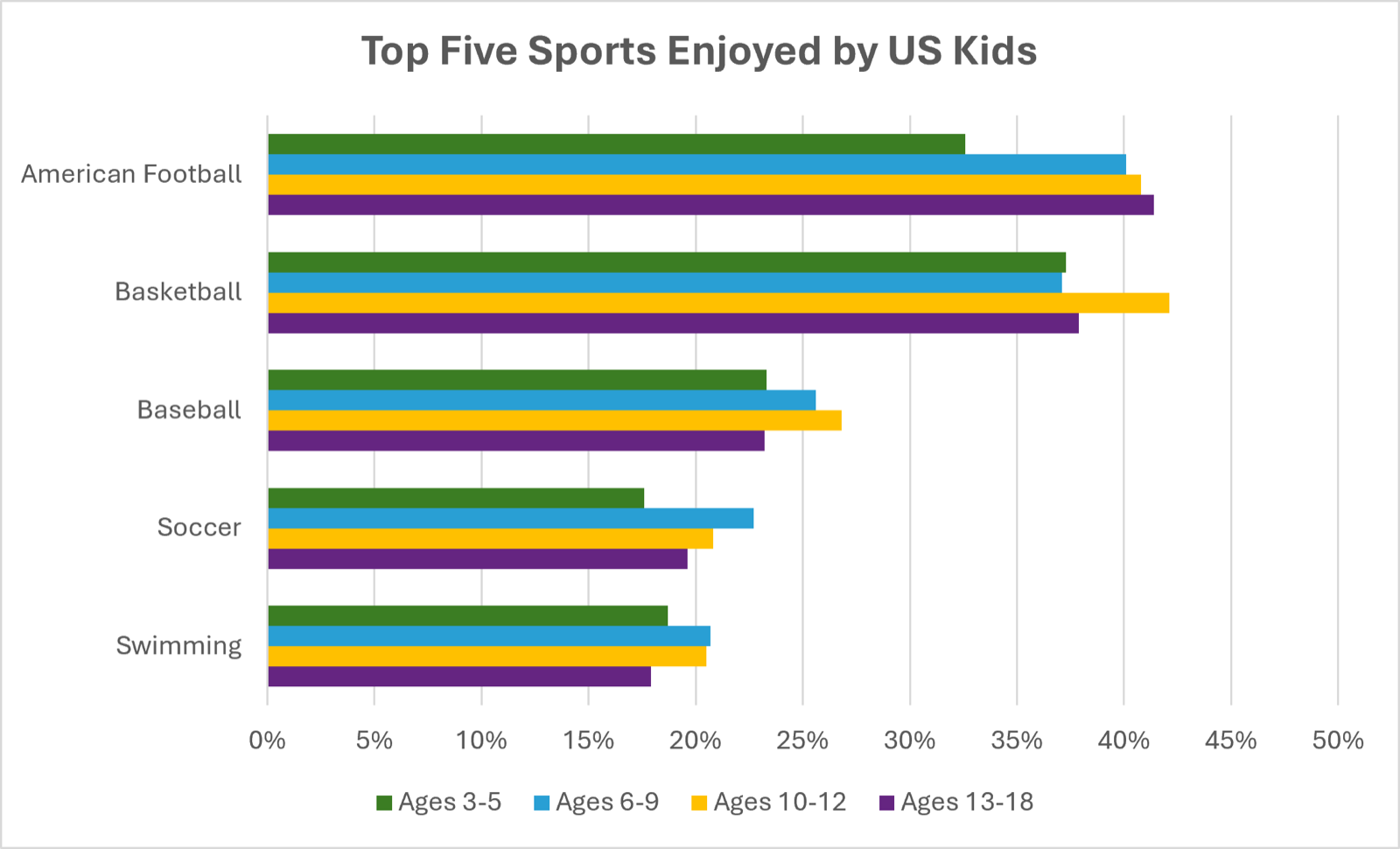
Beneath the established sports hierarchy, soccer is establishing a meaningful foothold among young audiences. Analysis reveals Gen A is growing up with soccer as part of a wider sports and entertainment repertoire rather than as a niche or unfamiliar sport.
Interest in the English Premier League nearly matches engagement levels with Major League Soccer (MLS), suggesting that kids and teens in the U.S. are connecting with soccer through globally recognised players, the established elite club brands and premium media experiences.
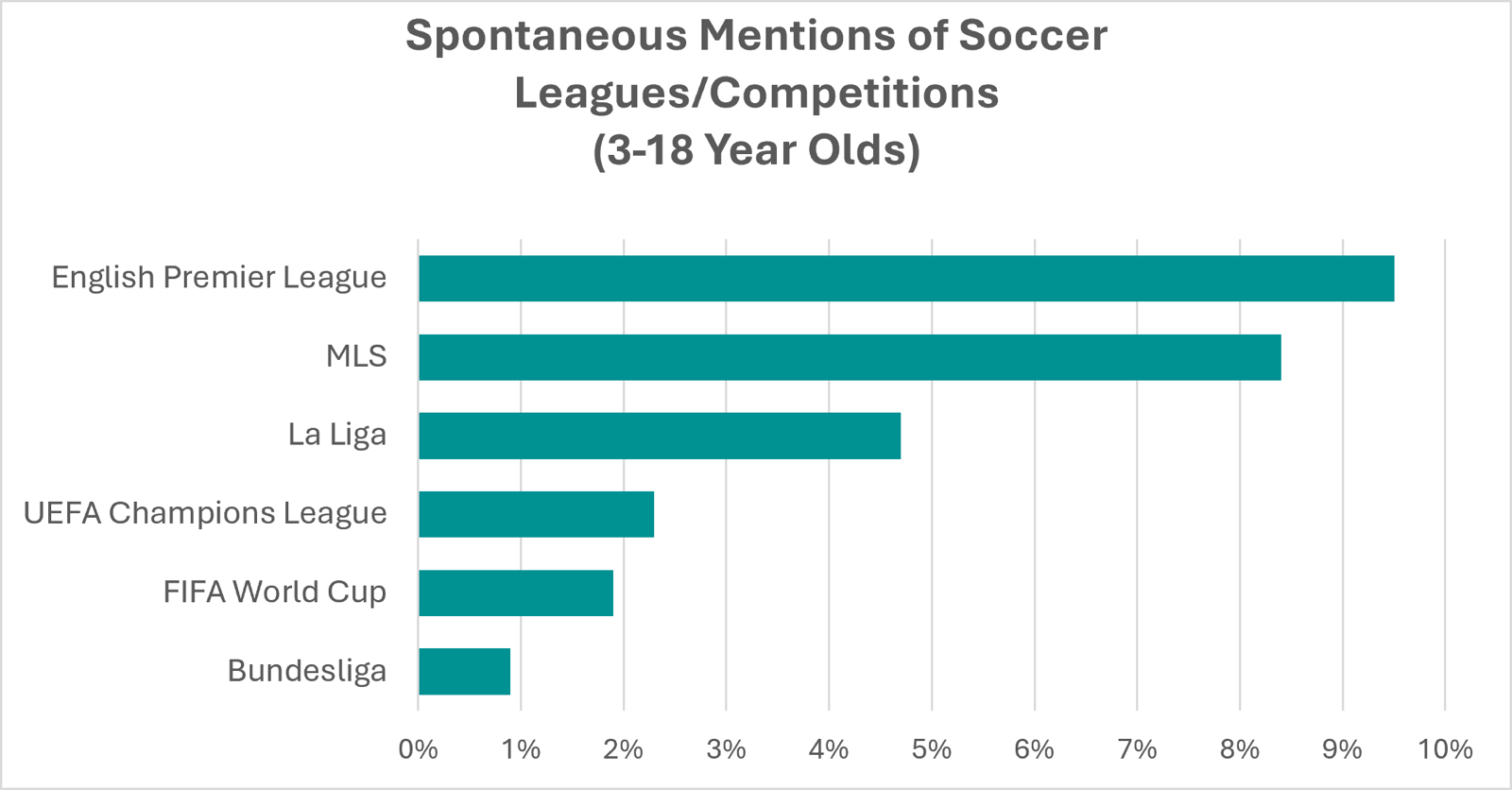
Contrasting with Mexico, the US audience behaves differently. Young Americans skew toward screen-led engagement with soccer, and this is evidenced by:
- Viewing exceeding participation (9% versus 8%)
- Online following is relatively strong (4%)
This creates a fundamentally different World Cup opportunity. In the U.S., soccer doesn’t need to behave like traditional grassroots sport to succeed. It can grow through creator narratives, highlights and clips posted to TikTok, video games, kids building fantasy teams and athlete personalities’ YouTube channels.
The legacy of the 1994 FIFA World Cup can still be seen today. Record attendances helped demonstrate the appetite for soccer in the United States and ultimately led to the creation of MLS in 1996. As the country prepares to host the tournament once again, the opportunity is arguably even greater. For many kids and teens, the 2026 World Cup will not simply be a sporting event but a cultural and entertainment experience capable of accelerating soccer's relevance within a landscape still dominated by the NFL, NBA and Major League Baseball.
Canada: football through participation and community
Canada’s relationship with football appears more participation-led than fandom-led. Ice hockey still dominates the national sports landscape, but football is increasingly visible among younger audiences, particularly through grassroots participation and organised sport infrastructure.
The data reveals Canadian kids and teens are more likely to play football than follow professional leagues or teams closely, which creates a distinctive engagement profile compared with both Mexico and the U.S.
Instead of being primarily driven by elite fandom or global spectacle, football in Canada appears more rooted, through participation in schools, local clubs, family activity, what might loosely be thought of a grassroots accessibility. As such, the World Cup opportunity among kids and teens in the country is likely to be activated differently.
The strongest engagement drivers may not be the renowned players or elite clubs alone. Instead, participation-focused experiences are likely to resonate more effectively, such as youth or school tournaments, community viewing events, activities for families and other grassroots football partnerships.
Canada presents a slightly different opportunity. Football is already part of kids’ and teens’ lives but their engagement is driven by participation. Canadian kids are more likely to play the sport than follow professional leagues or competitions, which presents the opportunity to build a stronger connection between the game they play and the game they watch. As the World Cup approaches, initiatives implemented at grassroots level, whether through schools, local clubs or junior tournaments are more likely to resonate than purely media-led activity. This should help turn existing participation into longer term engagement with football.
2. Football fandom is becoming multi-dimensional
One of the clearest findings across the data is that football fandom among young audiences is no longer defined purely by viewing. Today’s kid football fan inhabits a fragmented media landscape, making choices to consume content across multiple platforms. Young people engage with football through viewing matches live on broadcast or cable TV, watching highlights and clips, playing football related video games, checking social content, following creators and influencers, wearing merchandise, talking in the playground and kicking the ball about with friends.

This is especially important when considering younger audiences who may never attend a World Cup match in person. With ticket prices likely to remain inaccessible for most families, the commercial success of World Cup 2026 among young audiences will depend on how effectively the tournament activates participation beyond the stadium itself.
The strongest opportunities may lie in:
- Second-screen experiences
- Video game integrations
- Mechanics that drive social sharing
- Partnerships with athlete-creators
- Create family co-viewing moments
- Participatory content
From the data, it appears as through The World Cup, is functioning just like many other entertainment brands, i.e., as a connected entertainment network rather than simply a live sports tournament.
3. The gender opportunity
The data consistently reveals a substantial gender gap in passion for football across all three host nations. However, the existence of the gap is overshadowed by the scale of the untapped audience opportunity.
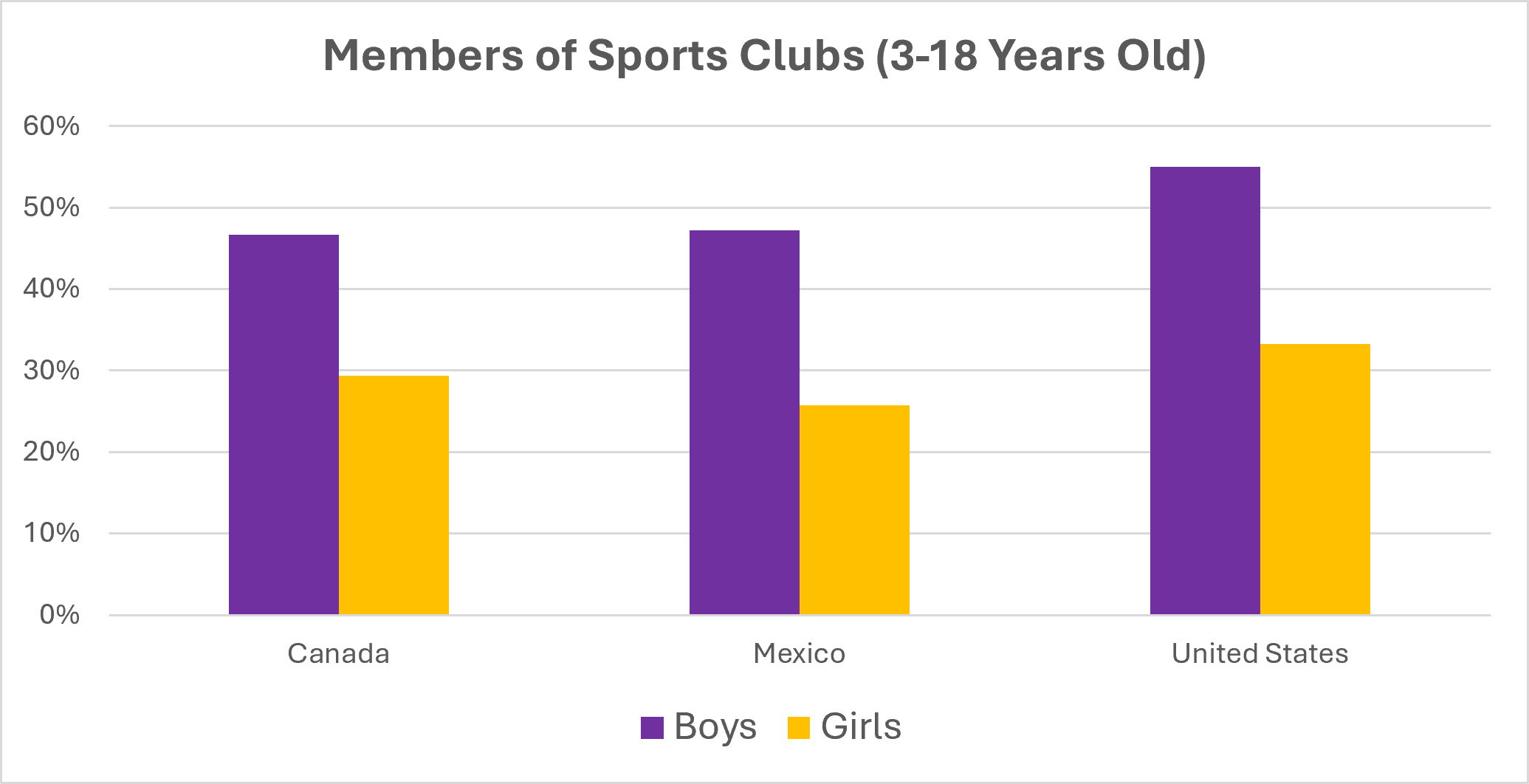
3in 10
Canadian girls are members of a sports club, increasing to nearly one in three in the US. The audience is active; the connection to football is the gap.
The Insights Family, Kids Insights, Canada and the United States, 2026.
The difference isn’t down to girls being less interested in football or sport in general. Far from it. Across the three host nations, girls are actively involved in sports clubs, dance classes and other organised activities. Three in ten Canadian girls are members of a sports club, increasing to nearly one in three in the US. The challenge is to find ways to turn that existing sports participation into a deeper connection with football and its competitions.
Therefore, the opportunity is to connect the World Cup to the interests and experiences girls already have. As a global event that extends beyond the pitch; the world Cup offers multiple entry points into football fandom. Content that reflects. Girls’ passions and interests and broadens perceptions of what football culture can be could help attract new audiences into the game during the tournament. This might include female player stories and perspectives, collaborations with influencers or creators, links to fashion and lifestyle trends, family experience and participation focussed initiatives.
4. The World Cup as a cultural event
Among young audiences, the FIFA World Cup is increasingly functioning as a cultural moment rather than just a sporting competition. This is especially evident in Mexico, where 7% of kids mention the tournament in playground conversations, more than any individual football club or team. By contrast, World Cup-related discussion is far less visible elsewhere in North America. In Canada, just 0.5% of kids reported talking about the tournament with friends, while in the U.S. it did not appear in the conversation data at all.
When asked to name any sporting leagues or competitions 4% of Canadian kids submitted ‘FIFA’ and a further 2% mentioned ‘FIFA World Cup’. In Mexico, ‘FIFA’ was typed in by 7% with a further 3% responding with ‘FIFA World Cup’. Kids in the US have the lowest spontaneous awareness of ‘FIFA’ (2%) and ‘FIFA World Cup’ (also 2%).
The chart below shows the level of interest in selected football competitions and leagues. The data suggests that the FIFA World Cup is the strongest and most universally appealing football property across North America, while interest in domestic and regional league is much more localised.
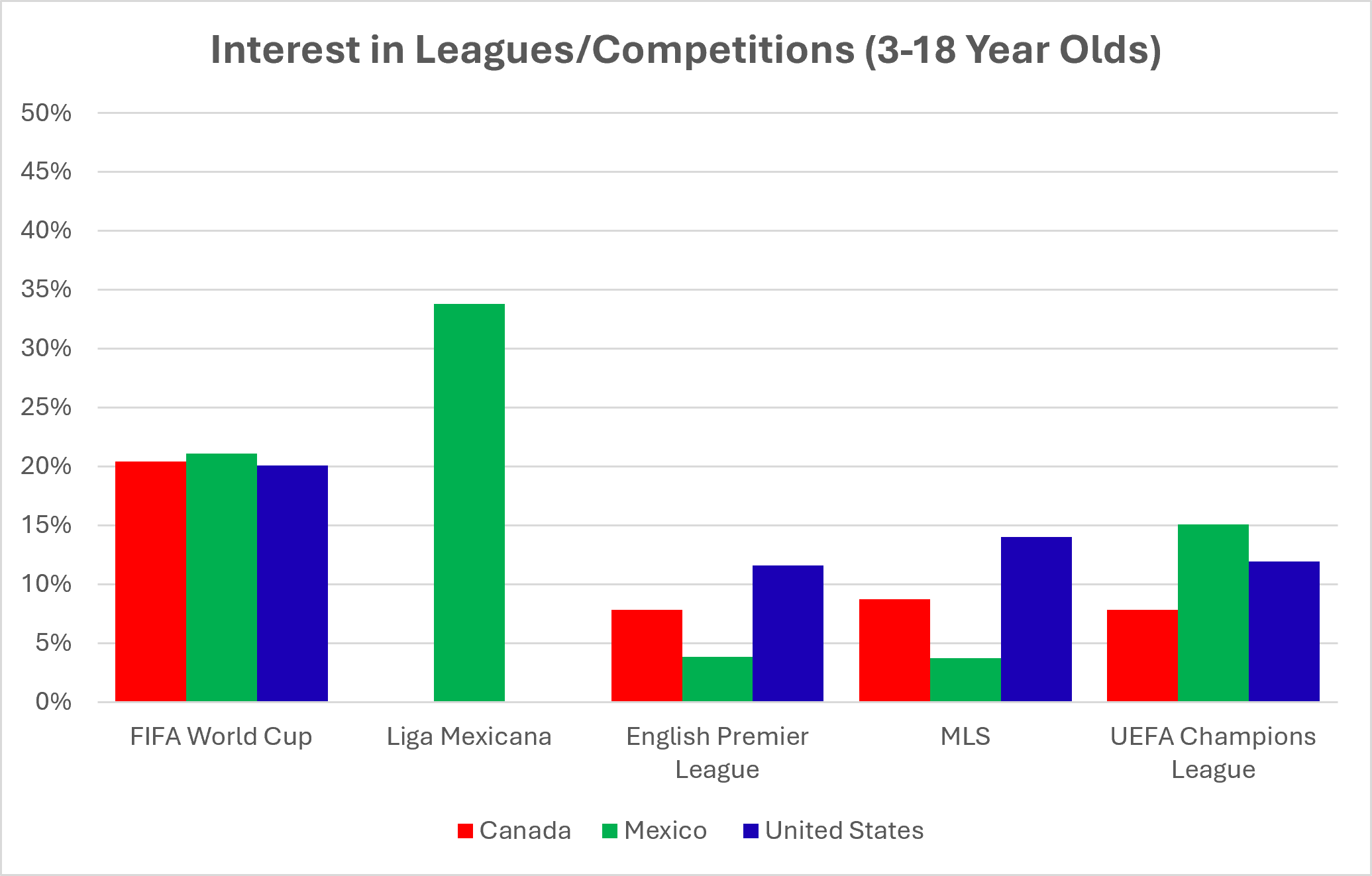
While football culture looks very different across Canada, Mexico and the United States, kids’ and teens’ interest in the FIFA World Cup is incredibly similar. Around one in five express and interest in the tournament (20% in Canada, 21% in Mexico and 20% in the US). Despite Mexico outperforming its neighbours to the north on almost every other measure if football engagement. The World Cup’s consistent appeal across the three countries highlights its unique ability to function as a universal cultural event. In many ways, it plays a different role to domestic leagues and club competitions., capturing the attention of young audiences regardless of how established football is within their local sporting landscape. The World Cup goes beyond generating awareness; it also generates enthusiasm. Between 10% and 13% are extremely interested in the tournament, making the FIFA World Cup the football property that inspires the strongest connection across the three nations.
As opposed to purely club-led football narratives, young audiences are responding to the forthcoming tournament through their passion for football, the spectacle of a global sporting event, and one being held in their country, as well as National identity. This is surfaced in kids’ peer-to-peer conversations, expressions and actions. This knowledge should influence how brands should think about activation.
When the Mexico last hosted the World cup in 1986 or the US in 1994, World Cup campaigns aimed at kids and families were most likely focussed on traditional brand sponsorships. This time, successful activations will:
- Integrate with entertainment culture
- Create participation mechanics
- Enable social sharing
- Connect online and offline experiences
- Build emotional rituals around the tournament
For younger audiences especially, relevance will come from being part of the moment, not simply watching it.
Every major cultural moment is an opportunity to understand what genuinely captures Gen Alpha's attention, builds their loyalty and earns their trust.
The FIFA World Cup 2026 is one of those moments. But the way kids and teens experience it varies enormously by market, by age and by culture. Understanding how this generation engages with sport, entertainment and the moments that matter to them is not straightforward, and getting it wrong means missing them entirely.
The Insights Family tracks kids and teens aged 3 to 18 across 22 markets. If you want to understand the latest thinking on how Gen Alpha thinks, what they care about and how to reach them, chat with our team.
All statistics from The Insights Family, Kids Insights, Canada, Mexico and the United States, 2025 to 2026 survey data.
Part one of our FIFA World Cup 2026 series, first published in June 2026.